Home / Past exams / October 2026 / Question 61
October 2026, question 61
Entry / Entry Summary · Liquidation, reliquidation and protests
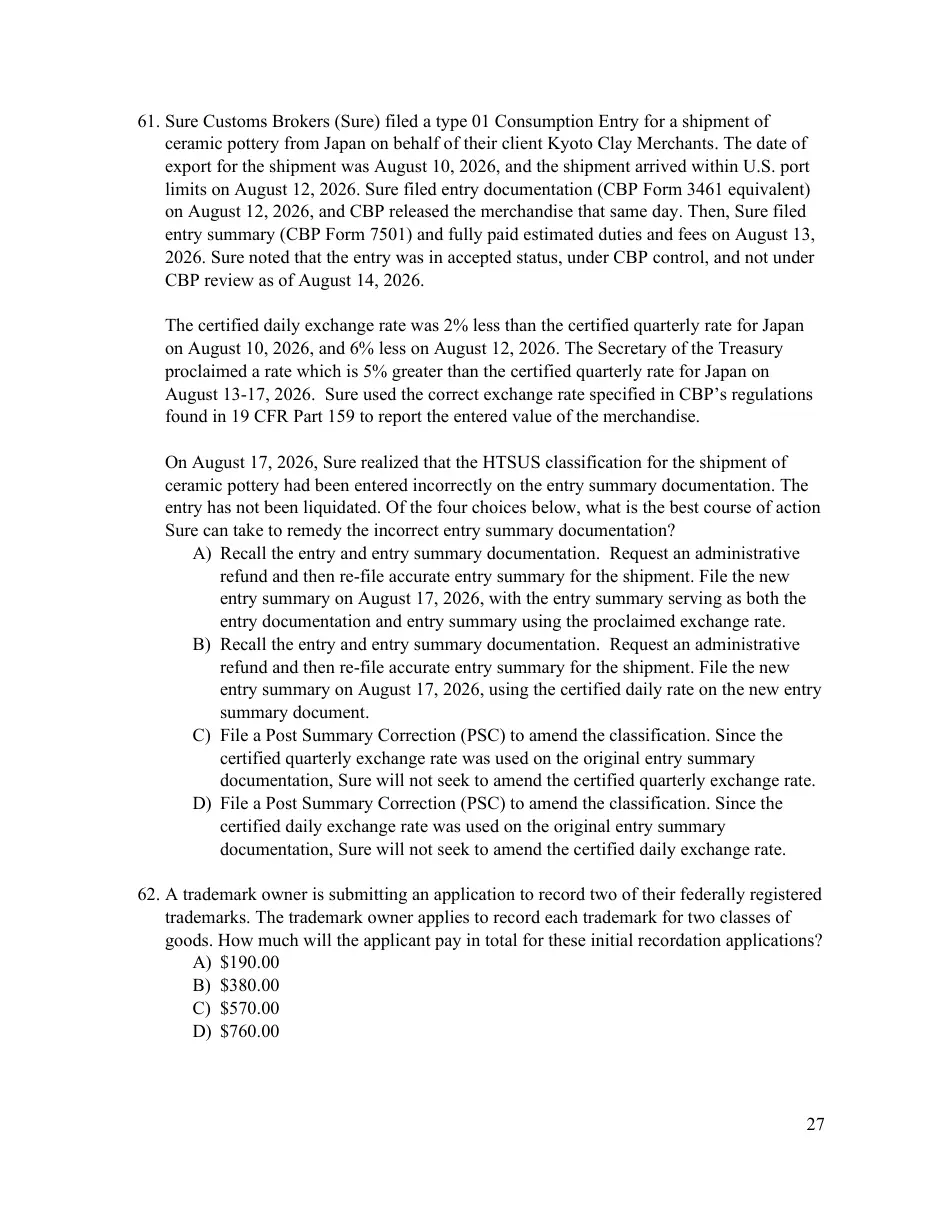
Sure Customs Brokers (Sure) filed a type 01 Consumption Entry for a shipment of ceramic pottery from Japan on behalf of their client Kyoto Clay Merchants. The date of export for the shipment was August 10, 2026, and the shipment arrived within U.S. port limits on August 12, 2026. Sure filed entry documentation (CBP Form 3461 equivalent) on August 12, 2026, and CBP released the merchandise that same day. Then, Sure filed entry summary (CBP Form 7501) and fully paid estimated duties and fees on August 13, 2026. Sure noted that the entry was in accepted status, under CBP control, and not under CBP review as of August 14, 2026. The certified daily exchange rate was 2% less than the certified quarterly rate for Japan on August 10, 2026, and 6% less on August 12, 2026. The Secretary of the Treasury proclaimed a rate which is 5% greater than the certified quarterly rate for Japan on August 13-17, 2026. Sure used the correct exchange rate specified in CBP’s regulations found in 19 CFR Part 159 to report the entered value of the merchandise. On August 17, 2026, Sure realized that the HTSUS classification for the shipment of ceramic pottery had been entered incorrectly on the entry summary documentation. The entry has not been liquidated. Of the four choices below, what is the best course of action Sure can take to remedy the incorrect entry summary documentation?
- Recall the entry and entry summary documentation. Request an administrative refund and then re-file accurate entry summary for the shipment. File the new entry summary on August 17, 2026, with the entry summary serving as both the entry documentation and entry summary using the proclaimed exchange rate.
- Recall the entry and entry summary documentation. Request an administrative refund and then re-file accurate entry summary for the shipment. File the new entry summary on August 17, 2026, using the certified daily rate on the new entry summary document.
- File a Post Summary Correction (PSC) to amend the classification. Since the certified quarterly exchange rate was used on the original entry summary documentation, Sure will not seek to amend the certified quarterly exchange rate.
- File a Post Summary Correction (PSC) to amend the classification. Since the certified daily exchange rate was used on the original entry summary documentation, Sure will not seek to amend the certified daily exchange rate.
Show the answer and walk-through
CBP's answer: C. C: File a Post Summary Correction (PSC) to amend the classification. Since the certified quarterly exchange rate was used on the original entry summary documentation, Sure will not seek to amend the certified quarterly exchange rate.
The right course is a PSC, because the entry summary is accepted, in CBP control, not under review, fully paid and not liquidated, which are the PSC conditions (BRPD 6.2), and a recall is only possible before the effective time of entry (141.67). The exchange rate does not need to change: for a date of exportation of August 10 the certified daily rate was only 2 percent from the certified quarterly rate, below the 5 percent trigger, and the proclaimed rate applied to later dates and was not the date of exportation, so the certified quarterly rate was the correct one (159.34(b)). That is C. D wrongly says the daily rate was used, and A and B recall an entry that has already been released.
The certified quarterly rate established under paragraph (a) of this section shall be used for Customs purposes for any date of exportation within the quarter, except in the following cases: 19 CFR 159.34(b)
The importer may recall the entry and entry summary documentation at any time before the effective time of entry 19 CFR 141.67
Search for: Certified quarterly rate
CBP's key cites: 19 CFR 141.67; 19 CFR 159.31; ACE BRPD Chapter 6
Question and key from CBP's October 2026 exam and answer key. The walk-through is ours; quotes are from the pinned editions in the reference viewer (HTSUS 2026 Basic, 19 CFR 2025 edition).